
Five Stages of Life
A reflective journey through the five stages of life, exploring how mindfulness can bring greater awareness, emotional balance, purpose, wisdom, and peace in every season we live.
Bill D. Blackburn Sr
8/22/1926

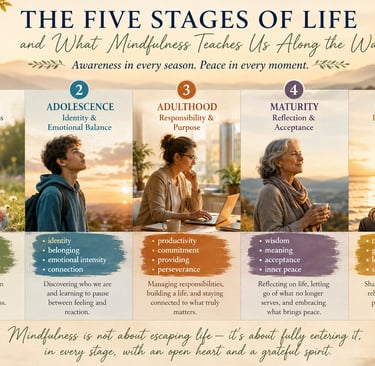
The Five Stages of Life — and What Mindfulness Teaches Us Along the Way
There comes a point in life when you begin to realize that growing older is not simply about aging. It is about changing. Every season of life asks different questions from us. Childhood asks us to learn. Adolescence asks us to discover who we are. Adulthood asks us to carry responsibility. Later years ask us to reflect, simplify, and eventually make peace with the life we have lived.
The older I get, the more I believe life is less about arriving somewhere and more about learning how to be fully present in each stage while we are there.
Psychologists, spiritual teachers, counselors, and philosophers have all described life in different ways, but many arrive at similar conclusions: life unfolds in stages, and each stage carries its own struggles, lessons, distractions, and opportunities for growth.
What fascinates me is how mindfulness seems to apply naturally to every one of those stages.
Not as a trendy practice.
Not as an escape from reality.
But as a way of learning how to actually live it.
1. Childhood — Learning Awareness
Childhood is where everything begins.
This is the season of curiosity, imagination, attachment, and discovery. Children are learning what safety feels like, how relationships work, and how to make sense of emotions they often cannot yet explain.
In many ways, children already live more in the present moment than adults do. They can become completely absorbed in a butterfly, a puddle, or a simple story. But they also feel emotions deeply and immediately.
Mindfulness in childhood is not about turning children into little monks sitting silently on cushions. It is about helping them recognize feelings before those feelings completely take over.
Simple practices can teach children to:
notice emotions
calm anxiety
improve attention
pause before reacting
develop empathy and compassion
The goal is awareness, not perfection.
Honestly, the more I study mindfulness, the more I think children may understand it naturally better than adults do. Adults spend years trying to return to the simple awareness children begin life with before the world teaches them to constantly rush, compare, perform, and worry.
That is part of why I am currently writing a children’s mindfulness book. Children today are growing up in a noisy world filled with stimulation, pressure, screens, distraction, and emotional overload. Helping them learn calm, awareness, and emotional balance early in life may be one of the greatest gifts we can offer.
2. Adolescence — Identity and Emotional Intensity
Adolescence is where people begin asking deeper questions:
Who am I?
Where do I belong?
What do I believe?
What kind of life do I want?
It is also a stage filled with emotional intensity.
Teenagers often feel everything deeply while simultaneously trying to fit in, stand out, gain independence, and survive enormous social pressure. Today’s adolescents are also navigating constant digital comparison and stimulation that previous generations never experienced.
Mindfulness becomes valuable here because it creates space between emotion and reaction.
Instead of:
“I feel this, so I must immediately act on it.”
Mindfulness teaches:
“I can notice this feeling without becoming controlled by it.”
That single shift can change a life.
Mindfulness helps adolescents:
slow reactive thinking
reduce anxiety
become less driven by peer pressure
observe thoughts without automatically believing them
build self-awareness and emotional regulation
I think many adults wish they had learned those skills much earlier in life.
3. Adulthood — Responsibility, Stress, and Autopilot Living
Adulthood is often the busiest stage of life.
Careers, marriages, parenting, bills, caregiving, schedules, setbacks, responsibilities, and endless obligations can consume years before people even realize how exhausted they have become.
Many adults spend much of life operating on autopilot.
Wake up.
Go to work.
Handle responsibilities.
Manage stress.
Repeat.
Mindfulness interrupts that cycle.
It teaches adults to pause long enough to notice what is actually happening internally rather than simply reacting automatically to pressure, frustration, fear, or exhaustion.
In adulthood, mindfulness can help people:
manage stress and burnout
become more emotionally present
improve relationships
recognize unhealthy habits
reconnect with personal values and purpose
make wiser decisions instead of reactive ones
Many people discover in midlife that they spent years constantly doing without truly being present.
That realization can be painful.
But it can also become transformative.
4. Maturity — Reflection, Reevaluation, and Acceptance
As people move into later adulthood, something begins to shift internally.
External achievement often becomes less important.
Inner peace becomes more valuable.
People begin asking:
What really mattered?
What have I learned?
What kind of legacy am I leaving?
What still gives my life meaning?
This stage often includes transitions:
retirement
changing health
loss
grandparenting
spiritual reflection
simplifying life
Mindfulness becomes especially important during this season because it helps people remain grounded during change.
Instead of constantly resisting aging, mindfulness teaches acceptance without surrendering dignity or meaning.
It helps people:
process grief
appreciate ordinary moments
cultivate gratitude
let go of constant striving
become less attached to productivity and status
Many people eventually realize:
“Life is happening now, not someday.”
That may be one of the greatest lessons mindfulness teaches.
5. Elderhood — Presence, Wisdom, and Peace
Traditionally, many cultures viewed elderhood as a sacred stage rather than merely “getting old.”
Elders were storytellers.
Mentors.
Keepers of wisdom.
Modern culture often fears aging because it worships productivity, speed, appearance, and achievement. But elderhood can become one of the most meaningful stages of life when approached with awareness.
This stage often involves:
reflection
storytelling
reconciliation
spiritual awareness
gratitude
preparing emotionally and spiritually for the end of life
Mindfulness during elderhood becomes less about achievement and more about presence.
Less about proving.
More about understanding.
Less about striving.
More about appreciating.
People often discover late in life that meaning was never found primarily in accomplishment. It was found in relationships, love, connection, forgiveness, growth, and the small ordinary moments that once seemed insignificant.
Mindfulness helps people stay emotionally and spiritually present for those moments instead of being trapped by fear, regret, bitterness, or anxiety about the future.
The Common Thread Through Every Stage
Across all five stages of life, mindfulness ultimately comes back to awareness:
awareness of thoughts
awareness of emotions
awareness of habits
awareness of relationships
awareness of life itself
The practices may look different at different ages, but the purpose remains remarkably similar:
to help us live more consciously, compassionately, and fully present in the life we are actually living.
The longer I study mindfulness, psychology, spirituality, and human behavior, the more convinced I become that mindfulness is not really about escaping reality.
It is about finally learning how to fully enter it.
Imagine an ancient tree. For decades it offered shade to strangers. Birds nested in its branches, travelers rested beneath its leaves, and children climbed its limbs. It survived storms, winters, droughts, and changing seasons. Simply by standing where God had planted it, the tree became a blessing.
Then the seasons changed.
The birds flew away. Travelers found other roads. The children grew older and began lives of their own. The tree became quieter. If it believed its worth depended upon how many people needed its shade, it might look at its empty branches and conclude that its purpose had passed.
But the tree was never sustained by those who gathered beneath it. Its roots reached deeper, drawing life from a source no one could see.
Our lives with God are much the same.
There are seasons when we are needed everywhere. We raise families, build careers, serve churches, care for others, solve problems, teach, lead, provide, and protect. Without realizing it, we can begin confusing being needed with being valuable.
Then our seasons change. Children grow up. Careers end. Responsibilities diminish. People move away or die. The telephone rings less often, and a life once crowded with activity becomes quiet.
And there is another kind of loss we seldom talk about: the loss of things that never happened.
As we grow older, we carry memories of the life we actually lived, but we also carry something resembling memories of lives we imagined. The trip we always intended to take. The relationship we hoped would heal. The career we might have pursued. The book we meant to write. The conversation we thought there would always be time to have. These events never occurred, yet their absence can feel strangely like losing a memory. We can grieve not only what was, but what might have been.
That can make the quiet years especially difficult. We look backward at what is gone and sideways at what never came to be, and begin asking, Does anyone still need me? Did I do enough? Do I still matter?
Christian faith gives us another way to measure a life.
Our worth was never determined by how much we accomplished, how many people depended upon us, or whether every dream became reality. Our worth rests in the God who created us, knows us, loves us, and calls us His own. Long before we accomplished anything, God knew us. Long after our productive years have passed, He remains.
Our deepest roots, therefore, cannot grow into usefulness, applause, position, productivity, or even yesterday’s dreams. They must grow into God.
That changes the meaning of solitude.
Two people can sit in nearly identical rooms and experience completely different worlds. One experiences the silence as evidence of everything that has been lost. The other gradually discovers that silence is not necessarily emptiness. It can become sacred space—a place to remember without living in the past, to grieve what never happened without bitterness, to give thanks for what did, and to recognize the presence of God who was there through all of it.
Perhaps this is one of the spiritual lessons of growing older. God may gradually loosen our grip not only on the things we once used to measure our importance, but also on the life we thought we were supposed to have. Not because our lives have become less valuable, but because He is inviting our roots to grow deeper.
The ancient tree may shelter fewer travelers now, but it is still standing where God planted it. Its weathered trunk carries the evidence of storms survived, seasons enjoyed, branches lost, and years faithfully lived.
And perhaps the question at the end is not, How many people still need me? Nor is it, Did my life become everything I once imagined it would be?
Perhaps it is simply, How deeply rooted have I become in the One who was with me through every season?
If you want to know more about Mindfulness, you may wish to look into my online Life Coaching practice or if you are in the Olympia, Wa. area, contact Olympia Mindfulness Therapy.
by Bill Blackburn